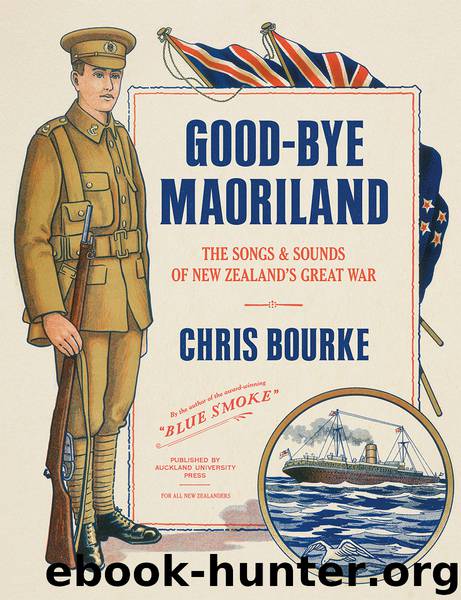
Good-bye Maoriland by Chris Bourke
Author:Chris Bourke
Language: eng
Format: epub
Tags: History
Publisher: Auckland University Press
Published: 2017-03-18T04:00:00+00:00
Te aroha
me
A huri noa te ao51
All around the world
NGATI RANANA: MAORI IN LONDON
While Maori soldiers in Britain for rest and recreation – or recuperation and rehabilitation – may have found some solace by expressing their culture, it was often because they were asked by their hosts or commanders to provide exotic entertainment. Rikihana Carkeek spent some months of 1916 in British hospitals and convalescent camps, recovering from a Gallipoli wound. In September he was based at Codford camp, Wiltshire – ‘no man’s land’ – when Sir James Carroll visited for ‘a little korero’ with Maori soldiers. Carkeek took part in a concert in the camp’s mess, Aotearoa Hut. ‘The Maori boys gave items. In the second half it was haka and Maori ditties. I gave five items, including “The Chivalrous Shark” (encored) and “Boot Black”. It was a most enjoyable evening.’ 52
There are suggestions that the activities of non-white soldiers on R&R were controlled and segregated because of the authorities’ fears of inter-racial sex.53 Certainly there were many polite functions for Maori only; the London home of expatriate singer Alice Scott was requisitioned for Maori soldiers’ rehabilitation but this was ‘to make sure they were culturally comfortable when they got out of hospital but needed to recuperate’. (Scott was Ngapuhi. With the stage name Princess Paera Nene, she had been performing in London for some years billed as the ‘famous Maori tenor’.)54 Te kuini o te ao Are the Queen of all countries Arohaina nei e au The place I love Ko koe tangihia I will cry for you Ko koe e mihia I will praise you in my thoughts Ko koe te kainga pai You are the most beautiful home The large house in Acton could accommodate up to fifteen Maori boarders, but welcomed a much bigger contingent for Christmas dinner, 1915. The meal – pigeons, pork, kumara – was cooked in a hangi, and the men sat down ‘in relays of 40 to 50’. Among them was ‘a gallant band of 40 Maoris invalided from the Dardanelles’, and a description of the event sent to the Auckland Star by ‘Our Lady Correspondent’ emphasises their exotic behaviour. New Zealand’s high commissioner, Thomas Mackenzie, arrived as the food had reached its ‘lushest’ and was lifted from the ground:
Eru Tato, in full war paint, rushed out of the gate and placed a white wand at Mr. Mackenzie’s feet as he jumped out of the motor. Then the brave forty, stepping out in line, sang and danced (with rolling eyes and gestures of a fierceness to curdle the blood of any Boche) a mighty ‘haka,’ at the end of which a gage of defiance was flung down to the Hunnish enemy they were defying.
More haka followed – waking the upmarket suburb ‘to its kinship with the remote and hardy Antipodes’ – before the kai arrived, accompanied by ‘every appropriate Maori ceremony’. After the meal, the soldiers performed ‘Hoki Hoki’, with Captain Pirimi Tahiwi providing a translation for the British: ‘Oft times your spirit visits me in my sleep and embraces me fondly.
Download
This site does not store any files on its server. We only index and link to content provided by other sites. Please contact the content providers to delete copyright contents if any and email us, we'll remove relevant links or contents immediately.
Aircraft Design of WWII: A Sketchbook by Lockheed Aircraft Corporation(32288)
The Great Music City by Andrea Baker(31920)
Call Me by Your Name by André Aciman(20505)
The Secret History by Donna Tartt(19064)
The Art of Boudoir Photography: How to Create Stunning Photographs of Women by Christa Meola(18622)
Shoot Sexy by Ryan Armbrust(17720)
Plagued by Fire by Paul Hendrickson(17407)
Portrait Mastery in Black & White: Learn the Signature Style of a Legendary Photographer by Tim Kelly(17005)
Adobe Camera Raw For Digital Photographers Only by Rob Sheppard(16969)
Photographically Speaking: A Deeper Look at Creating Stronger Images (Eva Spring's Library) by David duChemin(16684)
Ready Player One by Cline Ernest(14652)
Pimp by Iceberg Slim(14492)
Bombshells: Glamour Girls of a Lifetime by Sullivan Steve(14062)
The Goal (Off-Campus #4) by Elle Kennedy(13658)
Art Nude Photography Explained: How to Photograph and Understand Great Art Nude Images by Simon Walden(13038)
Kathy Andrews Collection by Kathy Andrews(11817)
The Priory of the Orange Tree by Samantha Shannon(9070)
The remains of the day by Kazuo Ishiguro(8982)
Thirteen Reasons Why by Jay Asher(8896)
